Since 1983 We have been providing your training needs

in both Basic and Advanced Medical Emergency Care.

Call us today at 1-800-968-5443


Instructor Jim Bovia

Jim Bovia

one of our instructor coordinators has this to say concerning our company's philosophy on training:

We at LSS Inc. believe it is imperative for our students to feel at ease during our courses. "My goal as an instructor is to try to lower my students anxiety level, no one retains knowledge easily under pressure.  I want them to concentrate on the entire picture, not just the test.  If I allow their mind to wander due to fear I will loose them and the overall point will be lost. I share my knowledge on resuscitation but also show them I'm a regular guy. I try very hard to include everyone in every bit of the class and I will always work with the student as long as necessary; making sure they understand the material to their satisfaction. The final outcome of utilizing Life Support Services Inc. for your emergent medical training will bring knowledge, confidence, and the ability to help a coworker, friend, or maybe even a family member in their time of need.
 
Contact us anytime with questions and let our staff give you the customized training you need.
 
Thank you
 
Jim Bovia, EMT-P

 
Call Us today for course information

1-800-968-5443


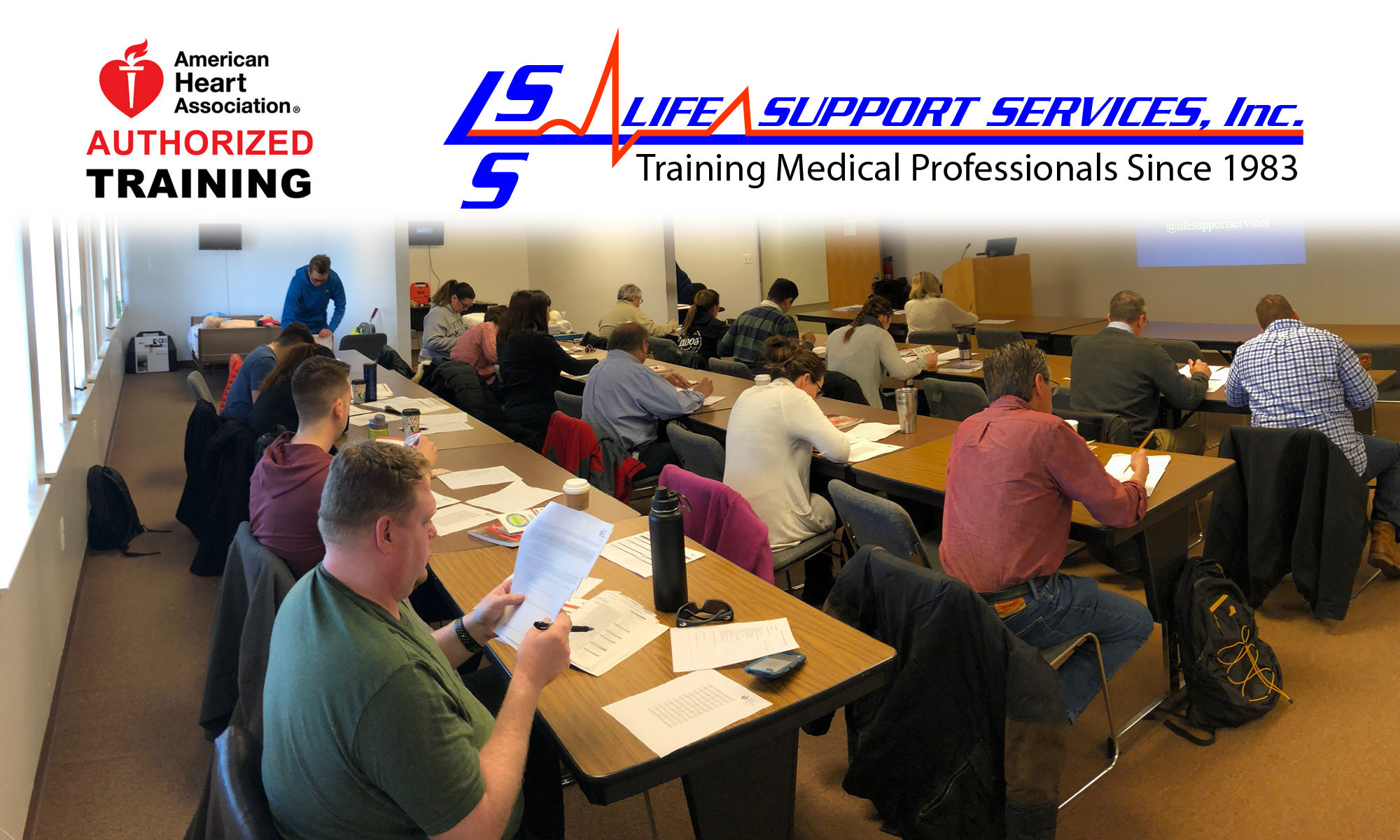
Life Support Services, Inc. is a proud member of the American Heart Association & a Community Training Center since 1983. Training more than 15,000 people combined last year in ACLS, PALS, & CPR.


We now offer CEU'S online.

All CEU credits are provided by the ENA.

We at Life Support Services remain committed to providing you with educational opportunities that assist you in maintaining your required resuscitation certifications to meet your employment requirements and more importantly to provide you with an educational experience that help you to provide the highest quality of care to your patients.  In keeping with this commitment Life Support Services has expanded our educational offerings from resuscitation specific courses to General CEU courses.  At this time Life Support Services is offering four CEU classes that will be offered as both seminars and webinars.  If you are not familiar with the webinar style of attending a conference, I would like to take a minute and point out some of the advantages to this form of conference.  First NO TRAVEL you are able to attend the course from the comfort of your home or any place that you have a computer and internet connection.  Second a webinar is not a recorded message that you just push play and hope you understand the message.  During a webinar you are logged into a virtual classroom with a live real time instructor and other participants.  You will view the slides on your computer and listen to the speaker either through your computer or on your phone.  Last you are able to ask questions and interact with the speaker and potentially the other participants

.Click here for more information

This continuing education activity was approved by the Emergency Nurses Association, an accredited approver of continuing nursing education by the American Nurses Credentialing Center’s Commission on Accreditation.


NRP CLASS

At our training center

April 28, 6pm to 8pm.


Dates for our upcoming 12 lead ECG Classes.

6-14-10 at 9am to 5pm

9-22-10 9am to 5pm

12-7-10 9am to 5pm

Register today


John Bovia Sr. CEO, EMT-P

was recently asked to write an article for the D.O.C.S Organization on Pediatric resuscitation. Here are his thoughts.

   In the fall of 2008 I was asked to submit an article for the winter digest, I enjoyed doing it and hope that readers found it helpful. This fall I have been asked to share my thoughts on the American Heart Association’s Pediatric Advanced Life Support program. Better known as PALS, this program has been a part of the American Heart Association’s emergency cardiac care training program since the mid-1980s. Many of you have ACLS (Advanced Cardiac Life Support) and may be asking yourselves if I already have ACLS why in the world do I need PALS? That’s a good question. The answer is that you need specialized training in pediatrics because kids are different than adults. Admittedly kids are more similar than different when it comes to emergency medical intervention, however the differences while few are significant.
To make my point, allow me to take this opportunity to outline the most significant differences between pediatrics and adults.

Let’s begin with the assessment, depending on the development stage of the child how we approach the critically ill child to perform our clinical assessment can have a significant impact on how effectively the child is able to compensate for whatever body system (respiratory or circulatory) is failing. In the Pediatric Advanced Life Support course we spend a fair amount of time discussing the pediatric assessment triangle, and how to perform a rapid cardiopulmonary assessment.

Next we move to medications. When we discuss the management of the acutely or critically ill adult patient or the adult patient in cardiac arrest for the most part drug doses are one size fits all. However, as you are well aware pediatric dosing is weight specific. Even for those children in cardiac arrest we must have an idea of the child’s weight and methods to rapidly determine the correct dose. In many cases this will require the aid of special reference material such as the Broselow tape. The Broselow tape is a reference device that, using the patient’s height or length, estimates weight and provides the correct emergency dosage. Again, rapidly converting recommended dosage per kilogram to the appropriate dose per patient is an important piece of the Pediatric Advanced Life Support program.

Of course we must address the question how to administer medications and fluids to the child in cardiopulmonary failure or cardiac arrest. Getting an IV on a small healthy child often presents a challenge to experienced healthcare providers even those physicians, nurses, paramedics, and IV technicians who start IVs routinely often find themselves frustrated in attempting to draw blood or start IV s on a small healthy child. The task may become impossible in the sick child. UNICEF estimates that 1.5 million children die every year throughout the world from dehydration in many cases simply because the healthcare providers available to them could not get IV access in order to rehydrate. As early as the 1980s, with the development of the PALS training program, the American Heart Association and the American College of Pediatrics recommended that all individuals who may be required to care for a critically ill child be trained in the placement of an inter-osseous needle.  In the Advanced Cardiac Life Support training program the ability to place an inter-osseous needle is considered a desirable skill, but in the Pediatric Advanced Life Support program is considered an essential skill.   For those of you who are not familiar with I/O therapy, any medication or fluid that can be placed through an IV can be placed through an I/O.   Becoming skillful at starting an I/O requires very little practice (far less than IV therapy) and it is a skill that is retained without persistent retraining or clinical practice.

Finally let’s talk about equipment. Certainly oxygen delivery equipment such as a partial rebreather mask, nasal cannulas, etc. will be of a different size.  When we talk about the delivery of positive pressure ventilation we have to look at the size of the bag valve. It is important that our attempts to ventilate are successful, but also that we not hyperventilate children this can lead to injury.  Last but not least, we will have to look at the automatic external defibrillator or AED. It is important that when dealing with children that we have the appropriate pediatric specific pads, which attach to our AED. 

In conclusion let me say that if you will be seeing children in your practice and certainly if you are going to consider providing sedation dentistry to children prudence dictates that you prepare to manage any emergency which may arise, for almost 30 years the American Heart Association’s PALS training program has been the nationally accepted standard for this training. I certainly hope to see you at an upcoming D.O.C.S course. Thank you and a good holiday season to all.

John Bovia CEO


DOCS EDUCATION

ACLS and PALS COURSES for the General Dentist.


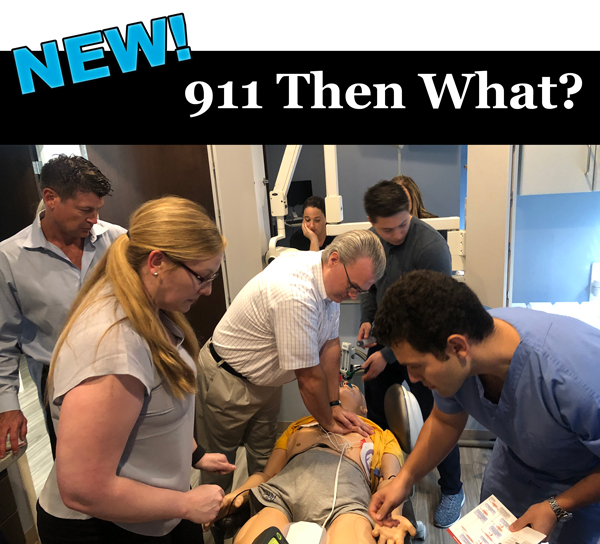
Lss, Inc. Is proud to congradulate Dr. Boudro and his staff on passing there first ACLS provider course.

Dr. Boudro is a General Dentist in Kennewick, WA . Sitting in the center of the picture is one of our many patient simulators.

What makes trianing with the simulator unique?

Richard Mason EMT-P

The Simulator is the size of an adult male. The student is able to communicate with the simulator through a computer program operated by the instructor. What else can the simulator do? He is as real as we can get without having a live patient. He has pulses at the radial, brachial, carotid, femoral, and pedal areas. As his blood pressure drops the pulses weaken or disappear. We can create just about any rhythm we want and if the simulator goes into a lethal rhythm the student can shock the simulator with an AED or monitor defibrillator.

Working with one of our simulators will make your training experience the most realistic.

Richard Mason EMT-P President of Life Support Services Inc.


Dr. Cynthia McKim

One of the many Dentists that have attended our ACLS program for D.O.C.S is credited with resuscitating and saving the life of a 5yr old child after he drowned in a swimming pool. The child was found pulseless and apneic after being pulled from the pool. Dr. McKim sent for an AED and started CPR. The child has made a full recovery thanks to her quick thinking and action.

Great Job Dr. McKim, and thank you for choosing LIFE SUPPORT SERVICES Inc. for your training needs.


Life Support Services Staff are waiting to work with you in our training center or your place of business.

Online ACLS courses for provider and recert?

Complete all classroom time on your computer at your leisure then come to our training center or one of our testing sites across the country to test-out with a certified AHA Instructor.


We Train:

Hospitals

Fire departments

Care facilities

Dental Office's

School's

and the list goes on.


Training we provide:

CPR

FIRST AID

ACLS

PALS

NRP